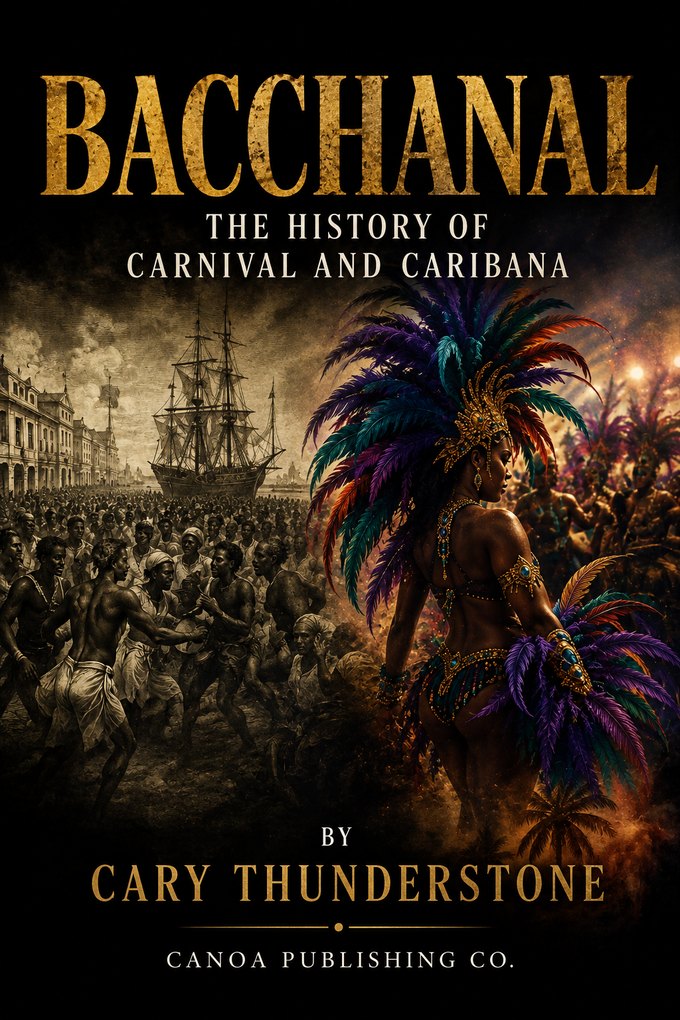
Bacchanal
The History of Carnival and Caribana
It started with a name that shouldn’t have repeated itself. Caribana — the festival that fills a Toronto August weekend with trucks, feathers, and flags — sits on top of a seventeenth-century map label for a stretch of coast the raiders, traders, and captives of the Indies moved through. Once the name catches your attention, everything else about the festival starts looking less like coincidence and more like inheritance.
Captivity into spectacle, spectacle into celebration, evidence into ornament — the same story, worn twice, generations apart, on the same stretch of ground.
Digital editions are DRM-free. Read or listen on anything you own.
What this book actually does
This is not an argument against the joy. It is an argument that the joy is standing on more history than anyone advertised.
The book traces the festival’s inheritance symbol by symbol — the truck, the flags, the naked body, the gold, the boat, the food, the flyer, the guest list — back to a documentary record most people carrying the symbols have never read.
None of it is secret history. Every fact is on the record, cited to the person who wrote it down — a conquistador’s proclamation, a queen’s decree, a cartographer’s mistake, a police captain’s crackdown, a newspaper’s food column.
What’s been hidden isn’t the material. It’s the pattern the material makes when you stop reading these as separate stories and start reading them as the same one.
Inside
About the author
Cary Thunderstone is a genealogist and independent researcher, and the author of When Did I Become African? His work reads festivals, censuses, and registers the same way: as documents, in the words they were actually written in.
Every claim in this book is held to the same rule as the rest of his research: document or discard. Where the record is blank, the book says so instead of filling it in.